
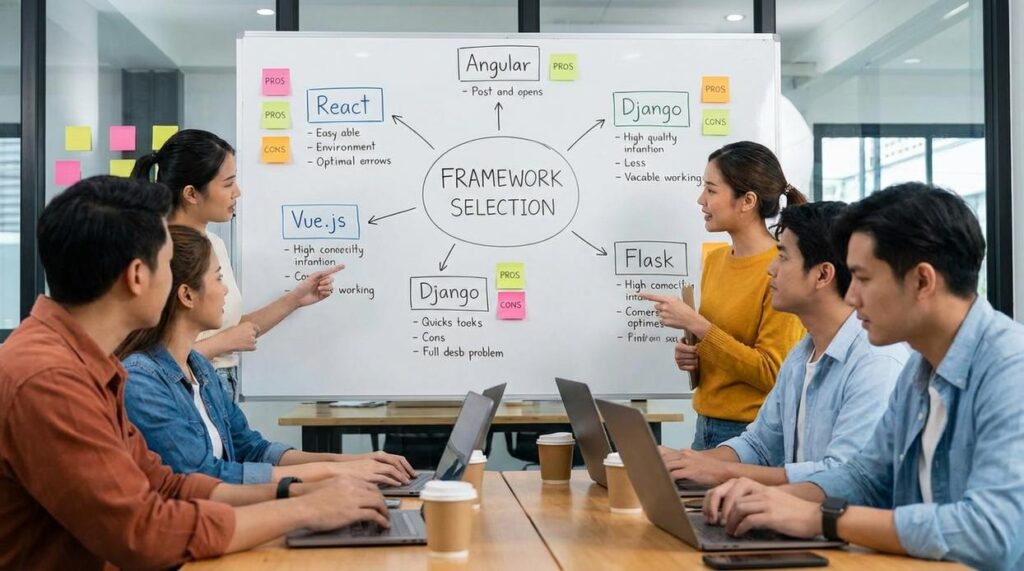
Before you write a single line of code, you’re faced with a decision that will define everything from your app’s scalability to your ability to hire the right talent down the road.
That decision? Choosing tech stack.
If you’ve ever felt stuck—torn between proven frameworks and shiny new tools—you’re not alone. This kind of “framework paralysis” is common, especially when the stakes are high and the pressure to move fast is even higher.
This article gives you something most others don’t: a structured, repeatable process to select the right framework for your project. No fluff. No bias. Just a model you can use again and again for any kind of build.
We’ve distilled this process from analyzing hundreds of real-world post-mortems and successful enterprise deployments. The result? A way to avoid technical debt, scale performance cleanly, and ensure your team won’t hit a hiring wall six months in.
You’ll walk away with clarity—and a solid methodology—for how to confidently choose the best framework for your project’s specific context.
Laying the Groundwork: Framework vs. Library vs. Language
Think of it like building The Matrix. You’ve got three critical layers: the language (code), the library (tools), and the framework (blueprint). Mix them up, and your digital reality’s going to glitch.
Let’s break it down:
- Language (e.g. JavaScript, Python): This is the raw syntax—the rules and vocabulary. Like choosing English or Spanish before writing a novel.
- Library (e.g. React, jQuery): Pre-written code you call to make life easier. Your code is the boss here (yes, even if it’s under-caffeinated).
- Framework (e.g. Angular, Django, Ruby on Rails): A full structure. It calls your code, flipping control (a concept called Inversion of Control). You’re not just coding—you’re committing to a way of thinking.
Some argue the distinction is just semantics. But try telling that to someone who built an app thinking React was a framework (it’s not).
Pro tip: When choosing tech stack, know what’s steering the ship—or face Titanic-sized refactors.
Understanding these differences isn’t nitpicking. It’s the difference between Stranger Things and just strange code.
The 5-Factor Framework Selection Model
Let’s not pretend choosing tech stack decisions happen in a vacuum.
Too often, I’ve seen teams lock themselves into a wrong-fit framework because it looked great on a slide deck or had hype on Twitter. (Yes, hype might win headlines—but it rarely writes maintainable code.)
This is why the 5-Factor Framework Selection Model matters. It pushes you to think holistically. But I also know some folks challenge the need for a checklist at all. They’ll say, “Just go with what worked last time.” Or worse, “Let’s use whatever’s trending on GitHub.”
Here’s the issue: past success doesn’t mean future-suitable. And trend-chasing? That’s how you end up rewriting major components six months in.
Let’s walk through why each factor is essential—and, selfishly, how it’s saved me more than once.
1. Project Scope & Business Requirements
Not all frameworks are built for the same purpose. Building an MVP might lean toward speedy prototyping in Flask, while a scalable e-commerce platform could beg for something like Laravel or Next.js (especially if SEO is king). Dismissing project needs for familiarity? That’s how performance bottlenecks sneak in.
2. Ecosystem & Community Support
Some push back here, saying internal devs can solve anything. But in reality, you’ve got deadlines—and Googling isn’t a dev strategy. A strong community ecosystem isn’t fluff; it’s a multiplier. Need proof? Look at the speed of issue resolutions in Laravel vs. obscure microframeworks.
3. Performance & Scalability
A framework’s architecture dictates how it responds under pressure. I’ve seen high-traffic apps crumble simply because the framework wasn’t designed for scale. Node.js’s non-blocking I/O isn’t buzzword bingo—it’s battle-tested for high concurrency.
Pro tip: Always check real-world benchmarks, not just marketing material.
4. Team Skillset & Learning Curve
Here’s where idealism meets reality. You may adore Elixir and Phoenix, but if your team only speaks JavaScript, prepare for delays. Upskilling sounds noble—until you’re six sprints behind. Sometimes the most impactful decision is leveraging what your team already does well.
5. Long-Term Maintainability & Governance
People underestimate this. Open-source passion projects can be brilliant—but brittle. Without a clear update roadmap or backing org, you’re at the mercy of maintainer availability. Choosing something with stable governance (think Google with Angular, or Meta with React) buys you peace of mind down the road.
Ultimately, this model isn’t about perfection. It’s about alignment—between tech, team, and long-term strategy. When you’re choosing tech stack tools that guide the next two years of product evolution, you can’t afford to get it mostly right.
That’s why checklists exist. Not to slow you down—but to keep you from hitting brick walls at full speed.
Explore more in building a scalable infrastructure best practices from industry engineers.
Frameworks in Action: Matching the Tool to the Job

Let’s move beyond theory.
The 5-Factor Model is great on paper, but how does it actually hold up when building real projects?
It turns out, pretty well—if you match the framework to the specific needs of the project. Let’s look at a few scenarios to show how this plays out in the wild.
For a Content-Heavy, SEO-Driven Site (e.g. Marketing Blog, E-commerce):
Frameworks like Next.js (React) and Nuxt.js (Vue) dominate here. Thanks to features like static site generation (SSG) and server-side rendering (SSR), these frameworks keep load times snappy and search rankings happy. According to a 2023 report by Vercel, sites using Next.js saw up to a 50% boost in Core Web Vitals performance metrics—critical for SEO.
For a Complex, Data-Intensive Web Application (e.g. SaaS Dashboard, CRM):
When managing complex logic, user roles, and deep data relationships, you need more horsepower. Django and Ruby on Rails shine, offering robust Object-Relational Mappers (ORMs), built-in user management, and pre-configured admin tools. Basecamp, built on Rails, scaled to serve millions of users with minimal overhead. (There’s a reason these frameworks are still favored in the enterprise world.)
For a High-Performance, Real-Time Application (e.g. Chat App, Live-Trading Platform):
Low latency is the name of the game. Node.js frameworks like Express.js and NestJS work wonders, thanks to their asynchronous, non-blocking I/O. A case in point: LinkedIn switched from Ruby to Node.js for its mobile backend and reduced servers needed by 90%.
For Rapid Prototyping and MVPs:
Need to build it yesterday? Lightweight tools like Flask (Python) or SvelteKit allow you to skip the boilerplate and get straight to testing your idea. (Pro tip: SvelteKit’s built-in transitions make even MVPs look polished.)
So, when choosing tech stack, don’t hunt for the “best” framework universally. Instead, pick the one that aligns with your project’s core demands.
Beyond the Code: Hidden Costs and Strategic Pitfalls
Let’s get one thing straight—choosing tech stack isn’t just a developer decision, it’s more like picking a life partner (one misstep and you’re explaining to your board why your app is held together with duct tape and deprecated libraries).
Some folks will pick the “easy” framework because it looks good on day one. But welcome to technical debt—that joyful moment when your past shortcuts demand compound interest in the future (usually during a product launch, of course).
Then there’s the hiring headache. Sure, that obscure framework had cool Reddit threads back in 2014—but now? Good luck finding developers outside an archaeologist’s LinkedIn network.
And don’t forget vendor lock-in. When your entire infrastructure depends on one company’s roadmap, pivoting can feel less like agility and more like escaping a cult.
Pro tip: If your framework’s community forum hasn’t had a post since 2021, run.
As you evaluate your options, staying updated on the latest trends is crucial, so consider checking out sources like Feedcryptobuzz Crypto News By Feedbuzzard to ensure your tech stack aligns with industry innovations.
Making a Strategic, Future-Proof Decision
Choosing tech stack isn’t just about what’s popular right now. It’s about making a foundational call that can make or break your project timeline, scalability, and long-term budget.
You came here looking for a reliable framework to cut through the noise—and now you have it.
The 5-Factor Model (Scope, Ecosystem, Performance, Skills, Maintainability) gives you a clear, repeatable path to reduce risk and make smarter tech decisions.
Your next move? Apply this model to your upcoming projects. Build not just for today, but for what’s next.
Struggling with your tech selection? Use the 5-Factor Model to eliminate guesswork. It’s helped hundreds of teams future-proof their builds. Try it now—before your next sprint stalls.