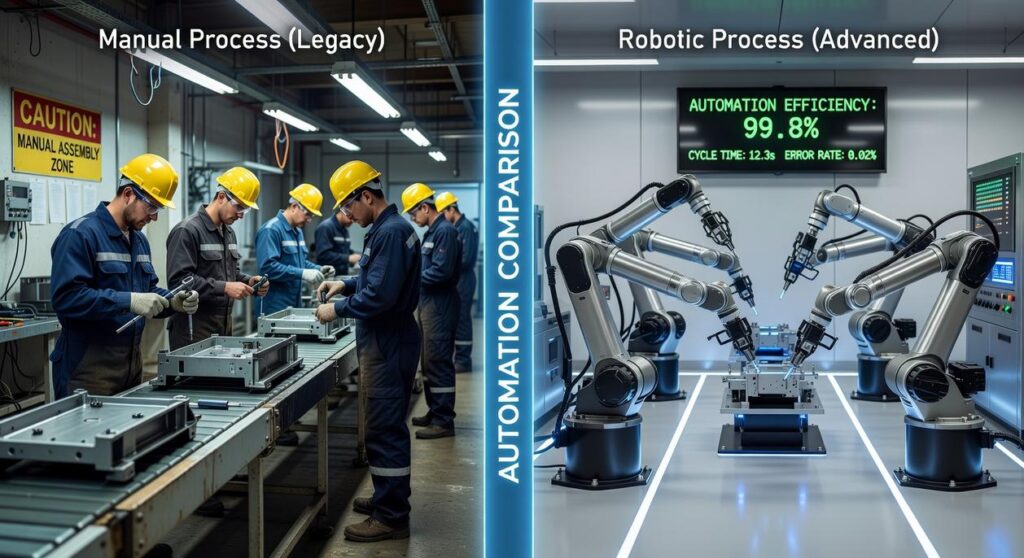
You’re here because you’re facing a critical decision: how to automate your business processes without wasting time or money.
If you’ve been researching solutions, you’ve likely come across a lot of overlap—and a lot of confusion—between rpa vs intelligent automation. The terms are often mixed up, but the technologies deliver significantly different outcomes. Misunderstanding these differences has caused many businesses to invest poorly and watch their automation projects stall or fail altogether.
I’ve spent years navigating automation deployments across industries, from finance to logistics. I know exactly where the confusion starts—and how to cut through it.
This article breaks down the real differences between rpa vs intelligent automation. Not just definitions, but how each technology performs in real business settings. We’ll give you a practical framework to evaluate them and help you decide which one aligns with your current needs and long-term goals.
If you’re aiming for clarity, efficiency, and a solution that won’t set your team back six months, this guide is where you start.
What is Robotic Process Automation (RPA)? The Digital Workforce for Repetitive Tasks
Let’s clear something up: Robotic Process Automation (RPA) isn’t some distant cousin of sci-fi robots. It’s software—bots that mimic human actions to handle repetitive, rule-based tasks on a computer. Think clicking buttons, filling out forms, copying data between applications. Exciting? Maybe not. But incredibly useful? Absolutely.
At its core, RPA is like a supercharged macro. It works best when dealing with structured data—spreadsheets, invoices, applications—anything that sticks to a predictable format. It operates on the user interface level, meaning it literally “sees” and interacts with apps the way a human would (which, yes, means a single update in your UI can suddenly break everything—ask anyone who’s had to debug one at 2 AM).
Now for the reality check: RPA bots don’t think. They don’t learn. They follow a script. If that script stops matching the system or the data changes, they crash. Hard.
Some folks argue it’s better to jump straight to more adaptive systems. But here’s my take: in the debate of rpa vs intelligent automation, RPA still wins for speed and simplicity—when used smartly. Just don’t expect it to solve problems it was never meant to. (Pro tip: Always version-control your bots.)
What is Intelligent Automation (IA)? The Brains Behind the Operation
Let’s challenge a common myth: that all “automation” is more or less the same. Spoiler alert—it’s not.
Many folks believe Robotic Process Automation (RPA) is all you need to scale automation. But RPA alone is like hiring a fast worker who never learns. It’s great at repetitive tasks—think cutting and pasting data or processing invoices—but the moment something unexpected hits? It freezes.
That’s where Intelligent Automation (IA) rewrites the playbook.
Also known as Hyperautomation or Cognitive Automation, IA blends Artificial Intelligence (AI), Machine Learning (ML), and RPA to handle entire workflows—not just bits of them. It can process unstructured data (like messy PDFs, emails, or even handwritten notes), make decisions based on previous outcomes, and adapt without human babysitting. (Yes, it remembers what it did last time—if only most humans could!)
Pro tip: NLP (Natural Language Processing) helps IA “read” and understand human text, while OCR (Optical Character Recognition) lets it digest visuals like scanned documents.
IA isn’t just automation—it’s evolution. So when debating rpa vs intelligent automation, remember: one’s a great assistant, the other’s practically your digital co-worker.
Head-to-Head: The Core Differences Between RPA and IA
At first glance, Robotic Process Automation (RPA) and Intelligent Automation (IA) might seem like two terms for the same thing. After all, both are about “automating work,” right? Not quite.
Let’s clarify the core differences so you’re not left treating them interchangeably (which is honestly where a lot of confusion begins).
Data Handling
RPA relies on structured and predictable data—that means spreadsheets, form fields, or databases where every value has a neat, labeled box. IA, however, can dive into the messy stuff: emails, images, PDFs, audio files. Because it integrates AI technologies like machine learning (ML) and natural language processing (NLP), it can extract meaning from unstructured or semi-structured data—just like a human would.
Decision Making
RPA is rule-bound. It follows a script, and if something deviates from that script? Cue the error. IA can actually learn from the data it’s given, spot patterns, and make proactive decisions. Think of RPA as following a recipe, while IA adjusts the seasoning as it goes based on how things taste.
(Pro tip: If your process involves nuance or exceptions, IA is probably the safer bet.)
Process Scope
RPA is a solid tool for automating isolated tasks—say, copying data from one system to another. But for multi-step workflows that involve judgment or cross-department activity? That’s where IA shines. It can orchestrate entire processes from end to end by integrating multiple steps, systems, and decision points.
Cognitive Ability
Here’s the heart of the matter. RPA has zero brain—it mimics actions but doesn’t understand them. IA, by contrast, can understand context, analyze sentiment, and interpret intent. That means responding not just with speed, but with insight.
Resilience & Scalability
One major limitation with RPA is its brittleness. Minor changes to a UI or system update can break scripts. (And IT teams love surprise updates.) IA’s learning capacity makes it more durable and scalable—it adapts to changes and continues functioning even when things shift.
Now, to settle the rpa vs intelligent automation debate once and for all: RPA works best for rule-bound, repetitive tasks. IA is your go-to for dynamic, decision-heavy, and full-scale process automation.
To explore how this impacts real people and workflows, consider the ethical considerations when automating human centered tasks. Because when automation gets smart, the stakes go up.
In short, IA doesn’t just do what it’s told—it understands why it’s doing it.
Practical Use Cases: When to Use RPA vs. IA

You’ve probably heard the buzz around automation—how it’s transforming industries, trimming costs, and boosting efficiency. But let’s get specific: when exactly should you go with Robotic Process Automation (RPA), and when does Intelligent Automation (IA) take the lead?
Here’s the breakdown backed by real-world patterns.
RPA is ideal when tasks are repetitive and rules-based. For instance, data migration between legacy systems and cloud-based CRMs is a classic RPA win. According to Deloitte, organizations using RPA report a 20% to 30% cost reduction on administrative processes. Throw in standardized invoice processing and generating recurring reports, and you’ve got a solid RPA case.
But the moment your task involves understanding, not just doing, IA steps in.
Let’s take intelligent document processing. Say you’re parsing hundreds of resumes with varying formats. IA platforms—powered by machine learning—can classify and extract key information far more accurately than rule-based bots. One insurance provider used IA to automate 80% of claims adjudication, cutting turnaround time in half (source: McKinsey).
And customer service? RPA may triage, but IA powers chatbots that understand customers, not just respond to keywords. (Ever yelled “operator” into a phone tree? That’s bad RPA.)
When it comes to rpa vs intelligent automation, the real skill is knowing who does what best. Use RPA when routine reigns. Use IA when insight matters.
The Synergy: How RPA and IA Work Together for Maximum Impact
Let’s clear this up—Intelligent Automation (IA) isn’t here to shove Robotic Process Automation (RPA) off the field. It’s more like upgrading from a calculator to a smartphone. Both have their place, but together? They’re a powerhouse.
Take this everyday scenario: a customer sends an email asking to update their billing info. An IA system reads the message, understands the intent (yes, it can really “think”), then hands it over to an RPA bot, which swiftly updates the CRM and fires off a confirmation. Smart meets fast.
Here’s where the rpa vs intelligent automation debate gets real. RPA excels at rule-based, repetitive tasks (think: clicking buttons, copying data), while IA brings smarts—handling unstructured input, learning patterns, and making decisions.
Trying to choose between them misses the point. It’s not either/or—it’s better together. The future of automation? It thinks and acts. Let that sink in.
From Task Automation to True Transformation
You came here to understand the difference between rpa vs intelligent automation—and now, you do.
Too often, businesses invest in automation only to see it underdeliver. The problem? They pick tools that don’t fit the task. That mismatch leads to wasted effort, rising costs, and stalled momentum.
We’ve shown you the smarter path: use RPA where speed and repetition matter. Use IA where the work demands logic, learning, and adaptability.
Your next step is clear: audit your business processes. Spot the patterns. Identify simple workflows ready for RPA—and flag the complex ones that need intelligent automation to truly deliver.
Stop pouring time and budget into disconnected fixes. Instead, match the right tech to the right task.
Start your audit now. We’ll help make sure your solutions drive actual transformation—because we’re the #1 rated source for AI automation insights with proven results that move business forward.